

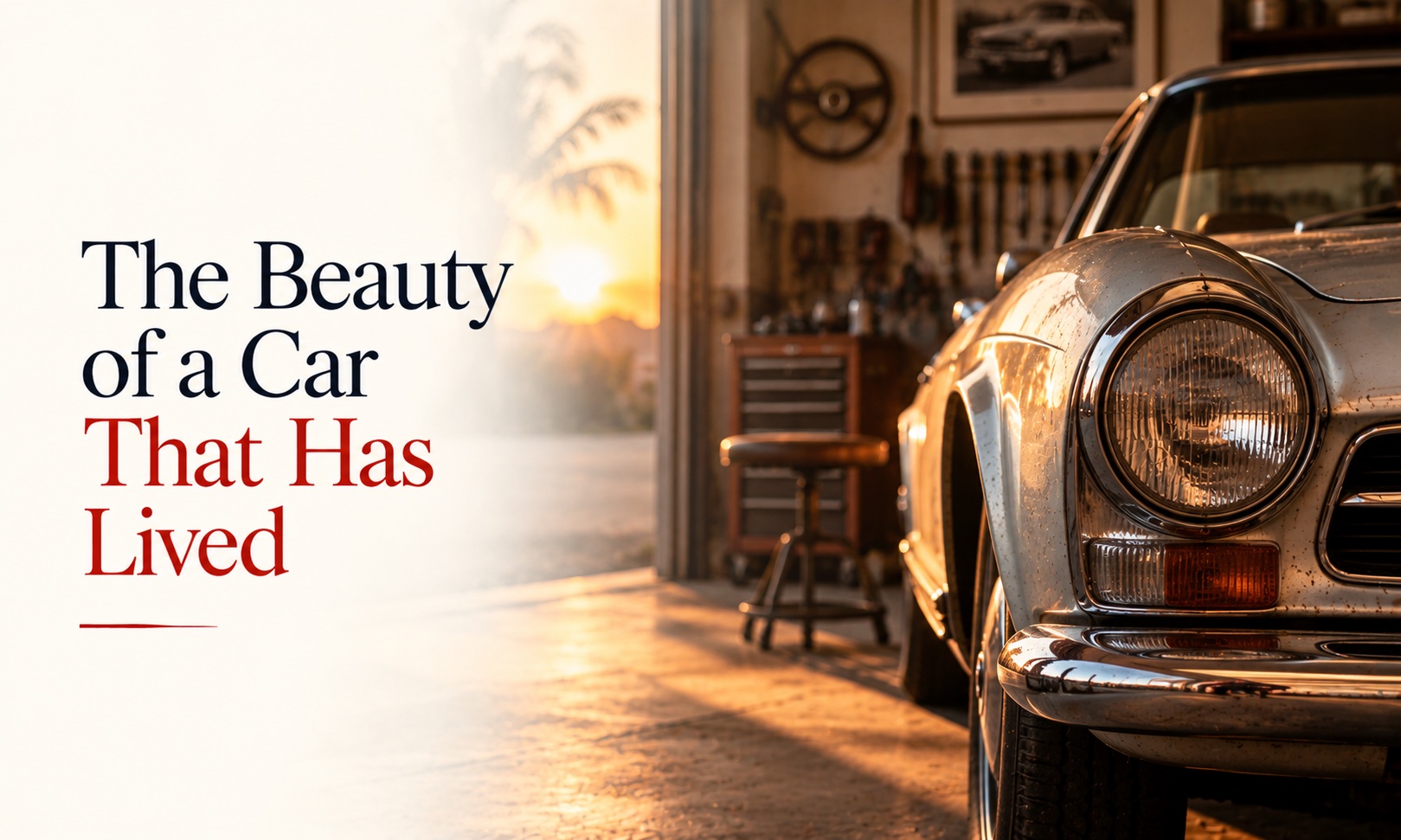
Why faded leather, worn steering wheels and small imperfections often tell a more meaningful story than a flawless finish ever could
There is a certain kind of restored car that is impossible to fault and strangely difficult to love.
The paint is immaculate. The chrome is perfect. The leather looks untouched. Every surface appears to have been returned to a condition so clean, so corrected and so complete that the car almost stops feeling like it has belonged to anyone at all.
And then there is the other kind.
The one with the slightly polished steering wheel. The leather that has softened and creased with use. The stone chips gathered honestly over years of driving. The faint wear on buttons, handles and trim that tells you this machine has not merely survived — it has participated.
That kind of car often feels more human.

“Perfection can impress. Patina can move you.”
Age is not always damage
Car culture can be oddly impatient with ageing. We speak about correction, restoration, rectification and making things “as good as new,” as though new is always the highest form a machine can take.
But age is not always the enemy of beauty.
A car that has been used properly acquires marks in the same way a favourite leather chair, an old watch or a well-read book does. The wear is not random. It settles in the places that matter. A steering wheel becomes smoother where hands have rested. A driver’s seat softens in familiar contours. Paint picks up tiny scars from roads it has actually travelled.
These are not always flaws.
Sometimes they are evidence.
A flawless car can tell you how carefully it has been stored.
A lived-in car can tell you how fully it has been enjoyed.
The difference between tired and honest
Of course, not all ageing is beautiful. Neglect is not the same thing as character. A broken interior, rotten trim or careless damage does not become romantic simply because time has passed.
The appeal lies in sympathetic ageing — the kind that comes from use, maintenance and affection rather than indifference.
A bonnet touched by stone chips because the car has seen highways. A little wear around the door handle because it has been opened thousands of times. Leather that shows years without looking abandoned. These details suggest stewardship, not carelessness.
The car has been lived with, not left behind.

“The goal is not decay. It is dignity.”
Why imperfection feels richer
Part of the reason sympathetic ageing is so appealing is that it makes a car feel specific.
A perfect restoration can sometimes flatten individuality. Everything is reset. Every trace of the car’s life is polished away. The result may be beautiful, but it can also become generic in its perfection.
A car with light wear, on the other hand, still carries its biography.
It tells you someone sat here. Someone drove this often. Someone reached for this switch, leaned on this armrest, loaded things into this boot and took this machine somewhere worth going.
The imperfections make the car harder to confuse with any other example.
And that makes it easier to care about.
From the Garage Floor
At Gear House Garage, restoration is not always about returning every surface to factory-new condition.
Sometimes the more interesting question is what should remain.
A steering wheel that still feels original in the hand. Leather whose creases took decades to form. A dashboard that has aged with grace. Certain marks are not failures to fix; they are parts of the story to preserve.
The best restorations are often not the ones that erase time completely.
They are the ones that know how to respect it.
That instinct requires restraint. It is easy to replace. It is harder to preserve wisely.
Because once every mark is erased, some of the life goes with it.
The cars that stay with us
Perhaps that is why so many memorable cars are not the flawless ones. They are the ones that feel as though they have arrived with some history still intact.
Not neglected. Not tired. Not unfinished.
Just lived.
A car that has been used properly carries a different kind of beauty — quieter, richer and far more difficult to fake. It reminds us that machines are at their most meaningful not when they have been protected from life, but when they have passed through it gracefully.

“A great car should not look untouched. It should look remembered.”