

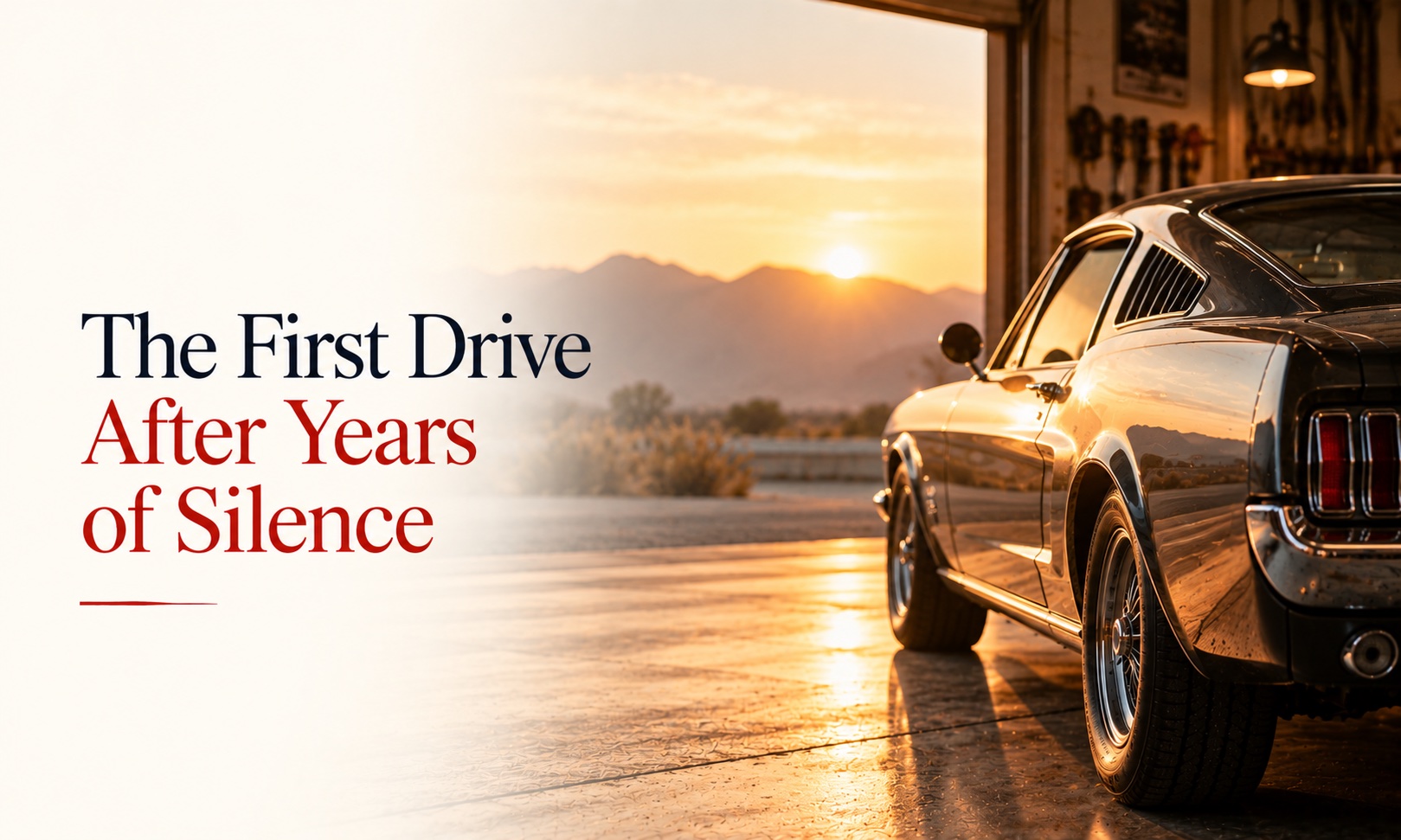
What happens when a car that has spent years standing still finally wakes up, clears its throat and remembers what it was built to do.
There is a particular kind of silence that settles over a car that has not moved in years.
Dust finds its way into the smallest gaps. Tyres lose their shape. Leather dries. Fuel turns old. The battery, naturally, gives up long before anyone is emotionally ready to admit that the car has stopped being “temporarily parked” and entered the more complicated category of “project.”
And yet, every time you pass it, you still see the car it used to be.
Not the dust. Not the flat tyres. Not the list of parts it now needs.
You see the road.
You remember the sound.
You remember exactly how it felt when the steering loaded up through a corner, or when the engine reached that part of the rev range where everything suddenly made sense.
Somewhere beneath the silence, the car is still there.
“The hardest part of bringing an old car back is not making it run. It is believing, for the first time in years, that it might.”
The day it finally starts
By the time the first startup comes, you have already imagined it a hundred times.
Reality is less cinematic.
There are tools everywhere. Someone is staring suspiciously at a fuel line. The battery has been charged, replaced, jump-started and blamed for several problems that were absolutely not the battery’s fault. Someone says, “Try it now,” with a confidence that nobody in the room actually possesses.
The key turns.
The starter moves.
Nothing.
Again.
This time, something almost happens.
And suddenly everyone becomes an expert in interpreting half a second of engine noise.
“That sounded better.”
It did not sound better.
But hope is an important diagnostic tool.
Then, eventually, the engine catches.
Not elegantly. Not dramatically. It coughs, stumbles, protests and fills the room with exactly the sort of noises that make sensible people reach for the ignition key.
Enthusiasts, naturally, lean closer.
For a few seconds, nobody talks.
You listen to the idle.
You watch the oil-pressure gauge like it owes you money.
You sniff the air and ask the ancient enthusiast question: “Is that normal?”
Nobody knows.
But the engine stays running.
And after years of silence, that is enough.
The car remembers before you do
The first drive is rarely a proper drive.
It is a tentative negotiation.
You ease the car out slowly, listening for every vibration, knock and unfamiliar sound. The brake pedal is tested approximately seventeen times before reaching the end of the driveway. The temperature gauge receives more attention than any instrument panel has enjoyed in decades.
Every noise is either catastrophic or “probably always did that.”
There is no middle ground.
Then something unexpected happens.
The steering begins to feel familiar.
Your hand finds the gear lever exactly where memory said it would be. The clutch bites slightly differently from what you remember, but somewhere within a few shifts, your body adjusts. A control you have not touched for years suddenly makes perfect sense beneath your fingers.
The car remembers before you do.
And then, slowly, you remember too.
“Muscle memory survives remarkably well when the muscle once loved the machine.”
The noises you forgot you missed
Old cars are never quiet.
That is part of the point.
There is wind noise around the door seals. The gearbox has opinions. Something behind the dashboard occasionally joins the conversation. The suspension reports information modern cars would consider unnecessary.
And then there are the noises that matter.
The engine taking load again.
The induction sound returning as the throttle opens.
The exhaust note bouncing back from a wall.
That strange mechanical chorus you once considered completely normal and now realise you have missed more than expected.
Of course, the car also introduces several new sounds you definitely do not remember.
That is why the first drive comes with the enthusiast’s most powerful coping mechanism:
“Let’s see if it goes away when it warms up.”
Occasionally, it does.
When it does not, you simply upgrade the sentence to:
“We’ll check that later.”

Then comes the moment
It rarely happens at speed.
Maybe you reach a familiar stretch of road. Maybe the engine finally reaches temperature. Maybe you turn into a corner and feel the chassis settle in exactly the way you remember.
For a second, the years disappear.
The restoration bills disappear.
The storage disappears.
The conversations about whether the car was worth saving disappear.
You are simply driving it again.
And suddenly the machine beneath you is no longer an old project occupying space in a garage.
It is your car.
Again.
That recognition can be surprisingly emotional.
Because restoring a car after years of silence is rarely only about reviving machinery. Often, it is about returning to something unfinished. A promise you made to yourself. A memory you refused to let become permanent.

“The best restorations do not take you back in time. They give you one more chance to continue from where you left off.”
From the Garage Floor
At Gear House Garage, a car that has stood for years is never just a matter of adding fuel and turning the key.
Everything that allowed it to stop safely has to earn your trust again before everything that makes it go gets to have any fun. Fluids, hoses, brakes, tyres, cooling, fuel delivery, electrics — the boring things are what make the emotional moment possible.
And yes, when an old car finally starts after years of silence, everyone in the workshop suddenly develops an urgent reason to stand nearby and pretend they were not emotionally invested.
Professionalism has limits.
There is usually a smile nobody admits to.
Then somebody notices a drip underneath the car.
“It’s not leaking.”
Pause.
“It’s marking its territory.”
Some jokes survive every restoration.
One more lap around the block
The sensible plan for the first drive is always the same: a short run, check everything, return to the workshop.
This plan lasts approximately until the car begins to feel good.
Then comes the sentence every enthusiast knows:
“Just one more lap.”
One more lap becomes another road. Another road becomes another ten kilometres. Suddenly somebody is explaining that this was necessary to “properly bring it up to temperature.”
This is technically plausible.
It is also how car people justify almost everything.

The first drive after years of silence is never perfect.
Something will need adjusting. Something will make a noise. The brakes may need bedding in. A gauge may behave suspiciously. There will almost certainly be another list waiting when the car returns.
None of that matters quite as much as it should.
Because the car returned under its own power.
The steering moved in your hands.
The engine pulled through the gears.
The road passed beneath it again.
And somewhere between the first nervous metre and the inevitable “one more lap,” something that had been silent for years became part of your life again.
“There are few sounds more emotional than an old engine running again — except perhaps the sound of the garage door closing behind it as you finally drive away.”