

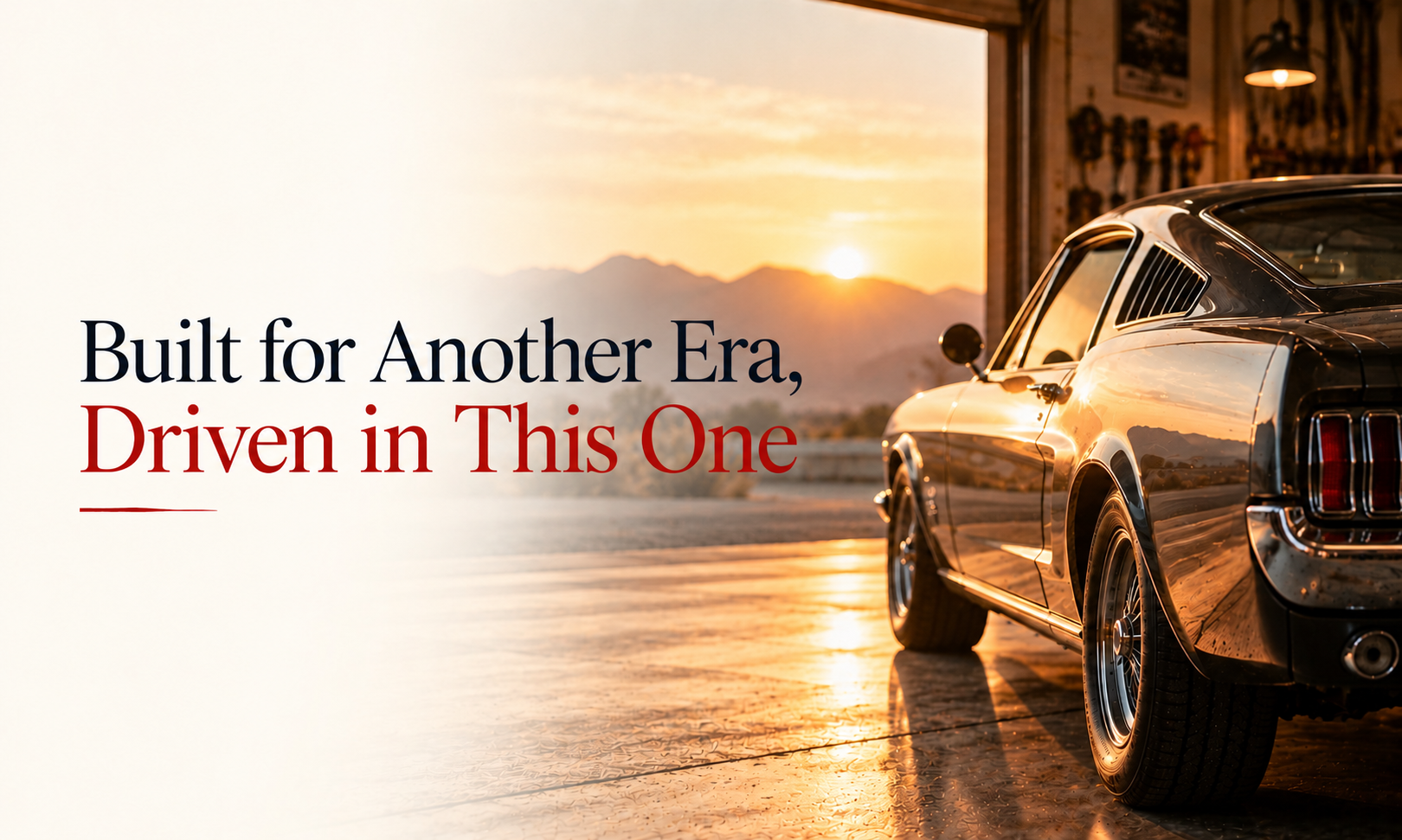
What it actually feels like to live with a classic today — the attention, inconvenience, conversations with strangers and the quiet satisfaction of choosing character over convenience
Owning a classic car today is a little like insisting on using a fountain pen in a world of voice notes.
It is slower. Less practical. Occasionally messy. Sometimes unnecessarily complicated.
And that is exactly why people love it.
A modern car asks almost nothing from you. It starts, cools itself, connects to your phone, warns you about everything and quietly removes friction from the experience.
A classic does the opposite.
It asks you to participate.

The world notices
Drive something old enough and anonymity disappears.
At traffic lights, people look over. At petrol stations, strangers wander across with questions. Somebody will inevitably tell you that their father had one, their uncle had one, or they nearly bought one in 1998 and have regretted it ever since.
Children point.
Older men smile.
And every third person asks the same question:
“How much is it worth now?”
Usually before asking what year it is.

The best part is that the conversation is rarely really about the car.
It becomes about memory.
Someone remembers family trips. Someone else remembers learning to drive in one. Another person stares at the badge for a few seconds and quietly says, “We had this exact one.”
That does not happen often with a crossover purchased last Tuesday.
“A classic car does not merely arrive somewhere. It tends to start a conversation when it gets there.”
Convenience has left the chat
Of course, romance becomes slightly less romantic at 2:15 in the afternoon when the air-conditioning has decided today is a philosophical rather than operational day.
Classic ownership involves accepting certain truths.
The brakes may require planning.
The steering may require forearms.
The windows may move at a pace suggesting they are paid hourly.
Bluetooth means placing a speaker somewhere it will not fly across the cabin under braking.
And “keyless entry” means remembering where you put the key.
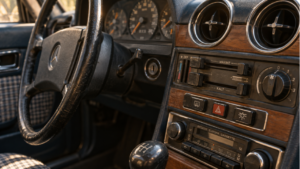
You also become remarkably tolerant of behaviours that would cause outrage in a new car.
A rattle? Character.
Slight oil seepage? Character.
Gearbox reluctant when cold? Character.
A smell that definitely was not there yesterday?
That one perhaps deserves investigation.
You plan differently
A classic changes the way you travel.
You check the weather. You look at the fuel gauge with suspicion. You know where the good workshops are. You may carry tools even if your mechanical expertise extends roughly to opening the bonnet and looking concerned.
Long journeys involve questions modern motorists rarely ask.
Will it overheat?
Will that noise get worse?
Should we fill up here?
Do we really need the AC?
And the eternal favourite:
“Was that light on before?”
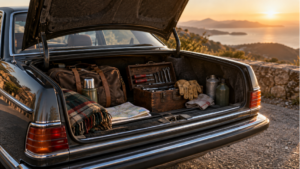
Oddly, none of this necessarily makes the journey worse.
It makes you more involved in it.
You notice temperature, sound, road surface and weather because the machine notices them too. You stop treating travel as dead time between locations.
The car makes the journey part of the event.
Fast becomes less important
One of the unexpected pleasures of driving an older car today is how little speed you actually need.
At perfectly legal velocities, there is already plenty happening.
The steering moves. The engine makes itself heard. The gearbox wants a decision from you. Wind enters places modern aerodynamics would consider unacceptable.
You are busy.
A modern performance car may need extraordinary speeds before it feels properly alive. A classic can make a roundabout feel like an occasion.

“A classic does not need to be fast to make you feel like you are driving.”
From the Garage Floor
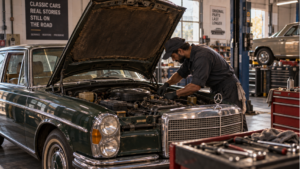
At Gear House Garage, classic owners often arrive with two lists.
The first contains the things that need fixing.
The second contains the things that absolutely must not be fixed because “it has always been like that.”
Learning the difference is part of understanding the car.
A slightly vague gear change may need attention. The ridiculous position of the window switch does not.
Restoration can make a classic more reliable and enjoyable, but making it behave exactly like a modern car can remove the very thing that made it worth keeping.
Sometimes improvement requires restraint.
Character costs something
Living with a classic is fundamentally an exchange.
You give up silence, seamless connectivity, perfect climate control and the confidence that every journey will unfold exactly as planned.
In return, you get texture.
You get smells, sounds, rituals, quirks and mechanical involvement. You get strangers waving at you. You get petrol-station conversations that turn into twenty-minute history lessons.
You occasionally get stranded.
Admittedly, that part is less poetic while it is happening.
But when everything is working, the appeal becomes difficult to explain and impossible to miss.

Modern cars are objectively better at almost everything.
They are safer, faster, quieter, cleaner, easier and more comfortable.
A classic does not win by pretending otherwise.
It wins because sometimes the most satisfying choice is not the one that makes life easiest.
It is the one that makes the journey feel like yours.
“Convenience gets you there. Character gives you something to remember on the way.”