

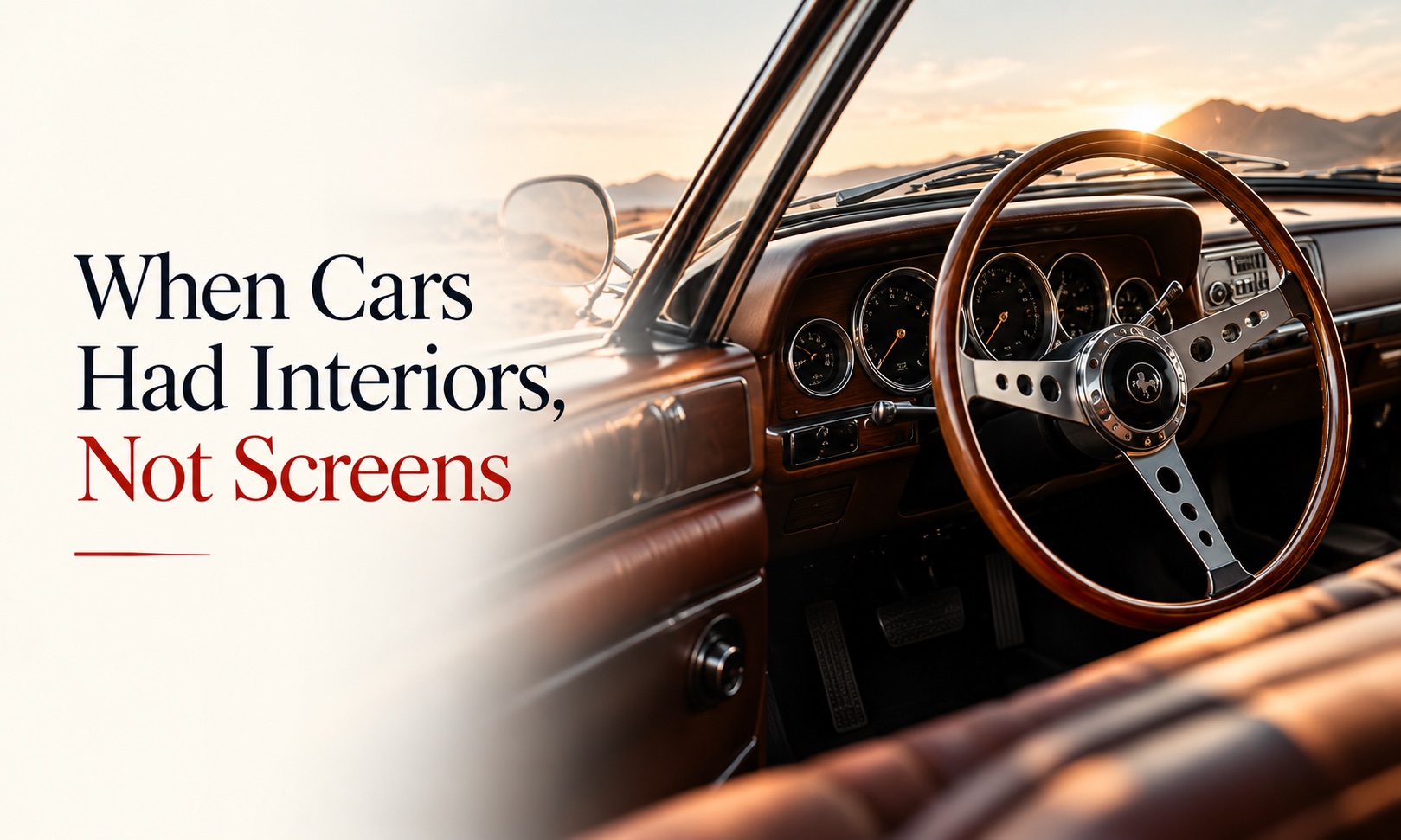
When Cars Had Interiors, Not Screens
Before cabins became interfaces, they were places — made of leather, wood, metal, awkward switches and hundreds of little decisions that gave every car a personality of its own.
There was a time when you could identify a car from the inside without seeing the badge.
A Mercedes did not feel like a BMW. A Jaguar could never be mistaken for a Porsche. An old Land Cruiser had almost nothing in common with a Cadillac, and that was precisely the point.
Their interiors were not designed around a screen.
They were designed around a machine.
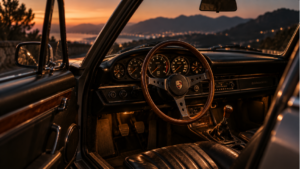
The first thing you noticed was often the smell. Leather that had spent years warming in the sun. Carpets that carried decades of journeys. Wood polish, vinyl, fabric, perhaps even the faint mechanical scent that seemed to travel forward from somewhere beneath the bonnet.
No startup animation could replace that first breath of a familiar cabin.
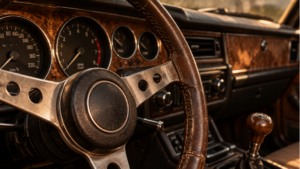
Materials were allowed to feel like themselves.
Wood looked like wood. Metal was cool under your fingertips. Leather developed creases exactly where thousands of journeys had asked it to bend.
Imperfection became evidence that the car had been lived in.
“Old interiors did not ask to be updated. They asked to be remembered.”
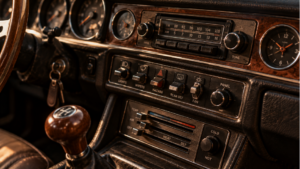
You knew what a control did before you looked at it.
A knob could be found in the dark. A switch had resistance. The click of an indicator, the pull of a headlamp control and the mechanical movement of a heater slider each gave the car its own vocabulary.
The controls were not hidden behind menus because they were part of the interior itself.
Perfectly imperfect ergonomics
Of course, none of this meant old interiors were always sensible.
Some switches appeared to have been placed wherever space remained. Electric-window controls could hide between the seats. The radio might require an unreasonable stretch. Cupholders, if provided at all, often seemed designed for cups from another civilisation.
And somehow, you learned all of it.
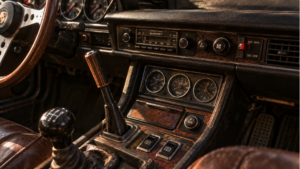
After a few months, the absurd layout stopped being absurd.
It became your layout.
Your hand travelled automatically to a switch nobody else could find. You knew which vent refused to stay pointed in the right direction and which button needed a slightly firmer push.
Familiarity turned poor ergonomics into affection.
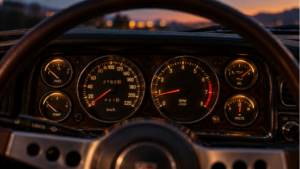
There was pleasure in watching machinery translate itself into movement.
The sweep of a tachometer. The slow rise of the temperature needle. A fuel gauge whose idea of accuracy you had learned not to trust completely.
You looked at instruments because they told you what the car was doing, not because they were competing for your attention.
“The cabin did not disappear when you switched the car off. It stayed in your memory.”
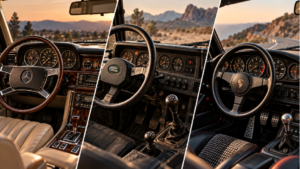
Perhaps that is what has been lost more than anything else: distinction.
A luxury saloon could feel like a private room lined in timber and leather. A sports car might arrange its entire cabin around the driver. A four-wheel-drive could be upright, durable and unapologetically functional.
The interior told you what the car believed it was.
Before you drove a kilometre, you understood its intentions.
From the Garage Floor
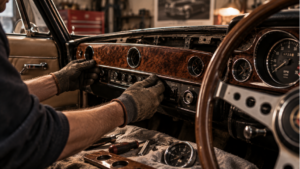
At Gear House Garage, restoring an old interior is rarely about making everything look new.
Sometimes the worn steering wheel should still look slightly worn. Sometimes original wood is more valuable than flawless replacement trim. Sometimes a switch carrying forty years of fingerprints belongs exactly where it is.
Restoration is not always the removal of age.
Sometimes it is the decision about which parts of age deserve to survive.
Today, our cabins can navigate, stream music, change colour, answer questions and display more information than yesterday’s entire dashboard could contain.
They are undeniably more capable.
But capability and character are not always the same thing.
Because years from now, we may struggle to remember which version of a touchscreen a particular car had.
We are unlikely to forget the smell of old leather, the click of a metal switch, the glow of an analogue dial or the ridiculous place someone decided to put the window controls.
Those things were inconvenient.
Those things were distinctive.
Those things made the cabin belong to the car.
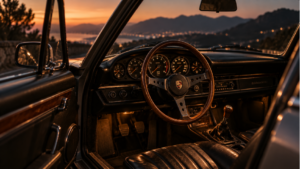
“Perhaps the great analogue cabins were memorable for the simplest reason: every time you opened the door, you knew exactly which car you had entered.”