

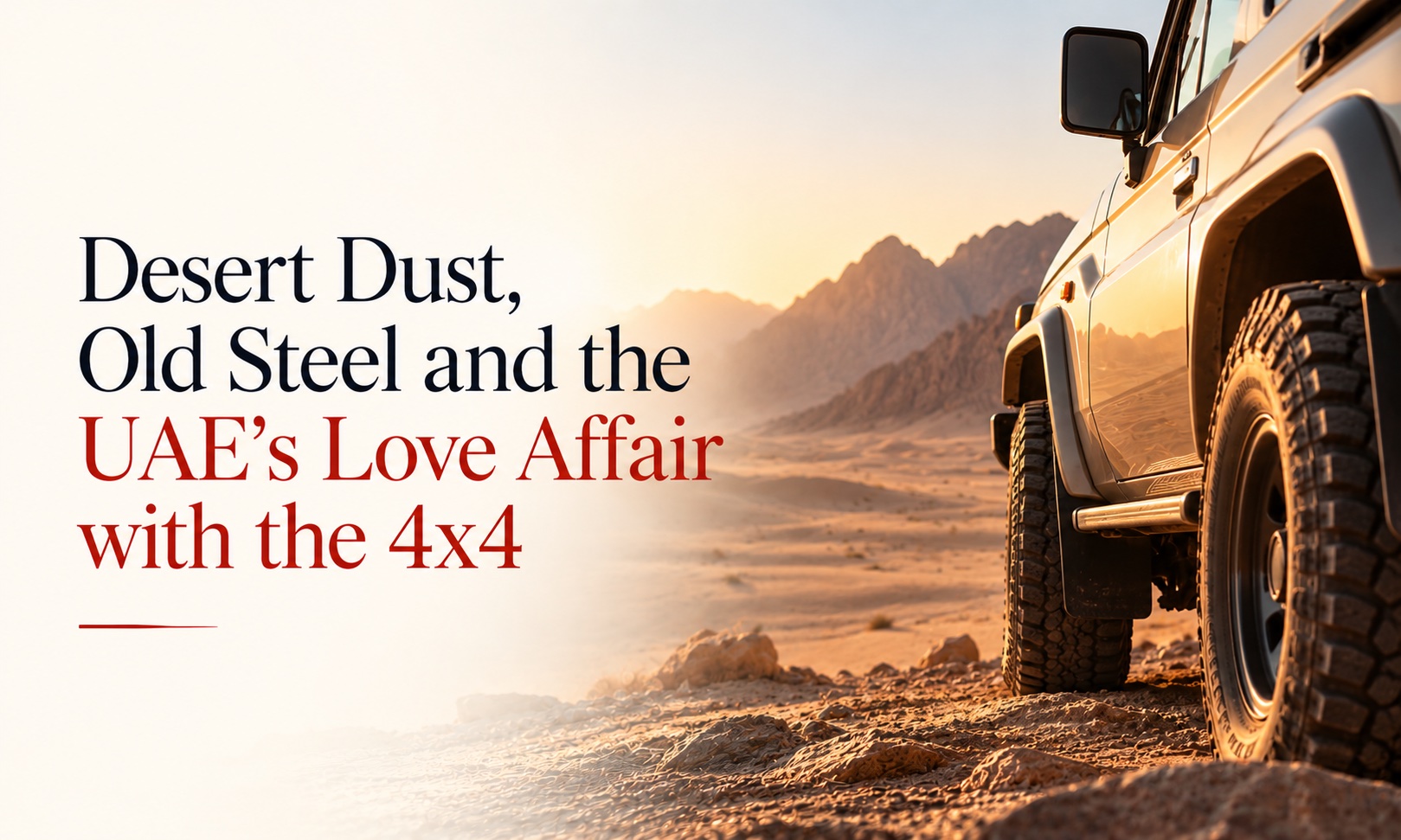
How the desert turned vehicles like the Land Cruiser and Patrol into something larger than transport
Long before SUVs became luxury statements, the 4×4 had a much simpler job in the UAE: it had to get through.
Across heat, sand, rough tracks and long distances, reliability was not a lifestyle feature. It was the difference between reaching where you were going and not reaching at all. Large four-wheel-drives became natural choices for families, farms and journeys beyond paved roads, and that preference carried forward across generations.
Somewhere along the way, utility became affection.

Built for the landscape
The UAE has a way of exposing weakness quickly. Heat tests cooling systems. Sand punishes poor traction. Long distances reward simplicity and dependability.
Vehicles such as the Toyota Land Cruiser and Nissan Patrol earned their reputation because they fitted that environment unusually well. The Patrol reached the Middle East in the 1950s, while the Land Cruiser’s lineage now stretches back more than seven decades. Both evolved from basic, rugged machines into increasingly comfortable SUVs without abandoning the capability that built their names.
That history matters because these cars were not introduced into the region merely as recreational off-roaders.
They became working vehicles, family vehicles and desert vehicles all at once.

A vehicle could take the family into town, carry what was needed for work, reach a farm and then leave the road entirely when the road stopped being useful. Contemporary accounts of Emirati car culture trace the enduring preference for large 4x4s partly to exactly this versatility — one vehicle capable of handling family life, work and regular desert journeys.
That creates a different kind of loyalty.
You do not remember a machine only because it looked good. You remember it because it was there.
“In the desert, reputation is earned one journey at a time.”
The shapes people grew up with
Ask someone who grew up around these vehicles and the memories are rarely about specification sheets.
They remember the tall bonnet visible from the passenger seat. Vinyl warmed by the sun. A spare wheel on the back. The heavy door. Sand appearing inside the cabin no matter how carefully everything had been cleaned.
They remember fathers, uncles and older brothers behind the wheel.
They remember sitting in the back on family trips, long before they were old enough to understand why this particular badge on the grille mattered.
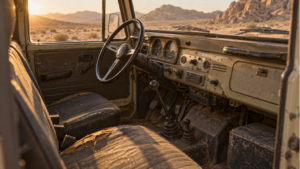
Suggested caption: For many people, these were not classic cars yet. They were simply the cars they grew up in.
That is why an old Land Cruiser or Patrol can trigger a reaction that a much rarer vehicle sometimes cannot.
Recognition comes first.
Then memory.
From tool to icon
The interesting thing is that neither vehicle remained primitive.
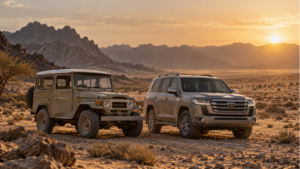
Each generation became quieter, more comfortable and more luxurious. The Patrol in particular developed an unusually strong relationship with the Gulf; Nissan itself describes the model as having become embedded in the region’s social fabric and has repeatedly launched Middle East-specific versions.
The Land Cruiser followed a similar path from utilitarian off-roader to a vehicle equally familiar outside a hotel as it is beyond the tarmac. Toyota UAE still describes its appeal in precisely those dual terms: serious terrain capability paired with everyday urban use.
Yet the older examples remain compelling because they show where all of that began.
Why the early ones matter
An old 4×4 does not need to be rare in the traditional collector-car sense to be culturally important.
Sometimes significance comes from familiarity.
A machine becomes important because thousands of families knew one, relied on one or have a photograph somewhere with one sitting quietly in the background.
The worn ones can be especially evocative. Faded paint, old steel wheels and a cabin carrying forty years of use may tell the story better than a flawless museum restoration ever could.
“Some cars become collectible because few people had them. Others become important because almost everyone remembers one.”
From the Garage Floor
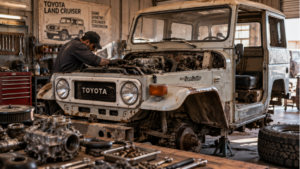
At Gear House Garage, restoring an older 4×4 is not simply a matter of making it shiny again.
The temptation is always to improve everything: smoother paint, newer trim, modern equipment, fewer imperfections. But with a vehicle carrying real history, the more interesting question is often what should remain.
A certain steering wheel. Original gauges. Period wheels. A colour remembered from decades ago.
Restoration is sometimes less about erasing age than deciding which parts of the story deserve protecting.
Today, the UAE is filled with extraordinary SUVs — faster, quieter, more powerful and more technically capable than those early machines could ever have imagined.
But when an old Land Cruiser or Patrol passes by, dusty and upright on its simple wheels, people still look.
Not necessarily because it is exotic.
Because it is familiar.
Because it belongs to the landscape.
And because in a country transformed almost beyond recognition within a few generations, some machines have managed to travel from the old UAE into the new one without ever becoming strangers.

“The UAE did not simply adopt the 4×4. It gave certain 4x4s a second homeland.”