

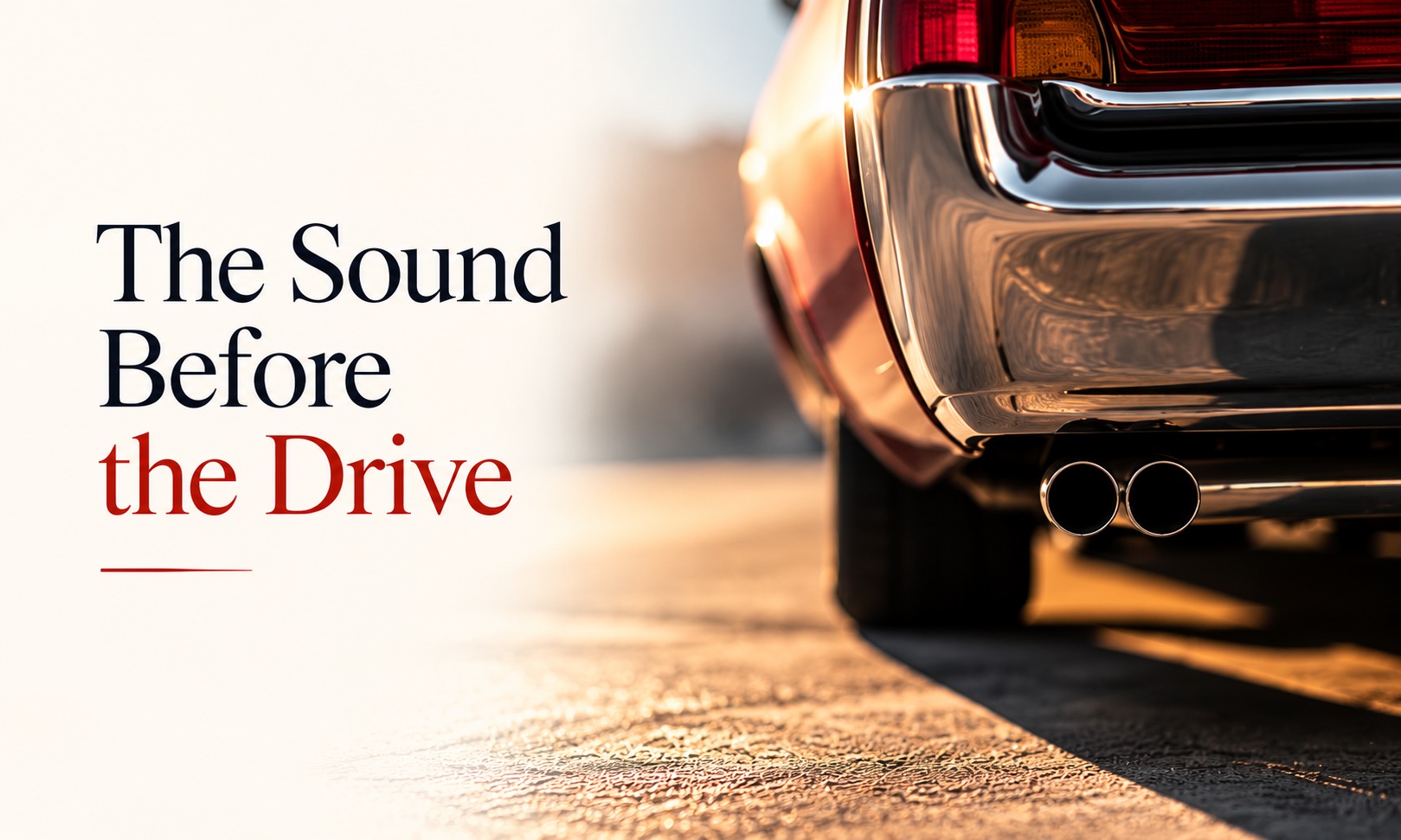
The Sound Before the Drive
Why the most memorable part of driving a special car sometimes happens before it moves at all
There is a moment with certain cars that begins before the road, before the speed, before the first turn of the wheel. It begins with a garage door opening.
Perhaps it is early morning, when the house is still quiet. Perhaps the afternoon heat has started to soften. The car has been sitting for a few days, maybe longer, and seeing it again feels oddly ceremonial. You walk towards it with the key already in your hand, knowing every step that follows.
The lock clicks. The door opens. The cabin releases its familiar smell — leather, vinyl, fabric, polish, faint traces of fuel and something else you could never quite name, but would recognise instantly.
Then you sit down.
For a few seconds, nothing happens.
And that pause is part of the experience.
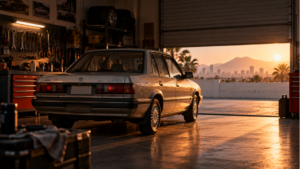
“With the right car, anticipation is not something that happens before the experience. It is part of the experience.”
A ritual you learn without noticing
A car you know well develops rituals around it. You know how far the door can open before it gets too close to the wall. You know which key is correct without looking. Your hand finds the bonnet release, the ignition and the switches almost instinctively.
The cabin feels familiar in ways specifications can never explain. You settle into the seat and your body remembers the position. The steering wheel feels exactly as it should. The mirrors are nearly right. Your hand reaches for a control before your eyes have found it.
An old car, especially, has its own atmosphere. The seat has softened in particular places. A button requires slightly more pressure than the others. The leather has aged. The plastics have their own smell. Tiny imperfections that might bother a new owner have long since become part of the car’s identity.
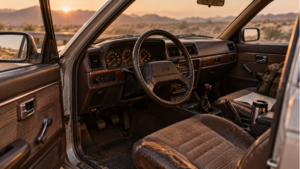
“The cars we know best are the ones our hands can operate before our eyes need to look.”
Then comes the key
There is a special silence just before an engine starts.
You are seated. The door is closed. The outside world feels slightly more distant. Ahead, the instruments are waiting.
Then the key turns.
With an older car, the moment can feel almost like a question. The starter spins. The engine catches. The revs rise, perhaps unevenly at first, before beginning to settle.
And you listen.
Not because the sound is necessarily beautiful. Cold engines rarely perform for an audience. They can be coarse, mechanical and slightly impatient. The exhaust sounds different against garage walls. A vibration may be more noticeable. A noise that disappears once everything is warm announces itself for a few seconds.
But if you have owned the car long enough, you know those sounds.
You also know when one of them is different.
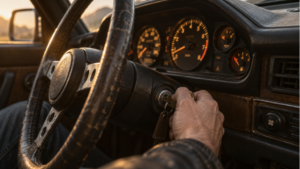
Waiting for it to become itself
The engine runs, but you do not move immediately.
The idle begins to soften. Needles settle. Warning lights disappear. What sounded slightly unsettled thirty seconds earlier becomes familiar again.
This is not wasted time.
It is recognition.
Owners of older cars become remarkably sensitive to these little signals. A starter that turns half a second slower. An idle that takes longer to drop. A noise that lasts five seconds when it normally lasts two. You may struggle to explain the difference to somebody else, but you hear it immediately.
Modern cars are extraordinarily good at hiding these processes. Older machines let you listen to them waking up.
Sometimes that means hearing things you would rather not.
But that vulnerability is part of the relationship.
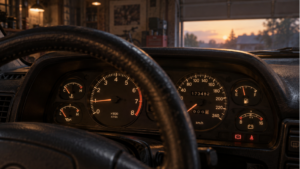
“The first few seconds after startup are not about noise. They are about recognition.”
The small things before movement
Then come the tiny acts nobody photographs.
The air-conditioning is adjusted. The window comes down. Sunglasses move from the dashboard. You check the fuel gauge and decide whether today’s drive requires a stop. A seatbelt clicks into place. Your hand rests on the gear lever.
With one car, you know second gear will feel stiff until everything warms. Another wants a particularly gentle first few kilometres. Another has an air-conditioning system that responds better to persuasion than expectation.
Technically, these are quirks.
Emotionally, they are character.

From the Garage Floor
At Gear House Garage, some of the most useful things owners tell us sound surprisingly vague.
“It doesn’t sound the same when I start it.”
“The idle is taking longer to settle.”
“It normally makes that noise, just not for this long.”
To someone unfamiliar with the car, these observations may not mean much. To an owner who has heard the same engine wake up hundreds of times, they can be remarkably precise.
Living with a machine teaches you its normal vocabulary.
And that is one of the differences between simply operating a car and actually knowing one.
The first metre
Eventually, the engine is settled. The mirrors are right. The belt is on. There is nothing left to prepare.
The gear engages and the car begins to move.
Tyres cross the garage threshold. The exhaust note changes as it leaves the enclosed space. The steering comes alive in your hands. Morning light catches the bonnet.
The drive has begun.
Yet somehow, much of what made it special has already happened.
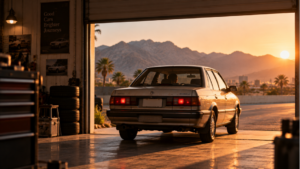
Car culture naturally celebrates what happens once a machine is moving — speed, roads, acceleration, corners and journeys. But some pleasures are quieter.
The garage door opening. The smell of a familiar cabin. The movement of analogue needles. The starter turning. The engine catching. The idle slowly becoming itself.
None of it is spectacular.
That is exactly why it feels personal.
A special car does not always need to be moving quickly to remind you why you love it.
Sometimes, it does not need to be moving at all.
“Before the road, before the speed, before the destination, there is simply the moment the engine comes alive.”