


Because you never really know a car until you have spent hours with it, watched the landscape change around it, and discovered what it is like when the destination is no longer the point.
There is a version of car ownership that exists mostly within a familiar radius. The weekend coffee run. The short evening drive. The occasional early-morning blast before traffic wakes up. The car is cleaned, admired, photographed and driven just far enough to remind you why you bought it.
There is nothing wrong with that. Some cars make even a twenty-minute drive feel special.
But a great car deserves, at least once, something more.
It deserves a full tank before sunrise, luggage in the boot, a destination several hundred kilometres away and enough road ahead for the relationship between driver and machine to change.
Because a long journey reveals things no short drive ever will.
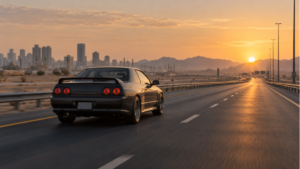
A road trip gives a car time to stop performing for you.
On a short drive, almost everything is an event. The steering feels sharp, the exhaust sounds exciting, the acceleration feels dramatic. You are hyper-aware of the machine because you have deliberately taken it out to enjoy it.
After three hours, however, the theatre fades.
What remains is character.
“A short drive shows you what a car can do. A long drive shows you what it is like to live with.”
The first hundred kilometres
The beginning of a road trip is usually full of optimism. The car has been checked, the fuel tank is full, the route is loaded and every kilometre still feels like part of the departure.
This is when you notice all the reasons you love the machine. The throttle response feels perfect. The steering has exactly the right amount of weight. The engine settles into its rhythm. Even familiar controls somehow feel more purposeful because today they are taking you somewhere.
Then the kilometres begin accumulating.
The road straightens. Traffic thins. Conversation settles down. You stop actively analysing the car and start simply travelling in it.
That is when the more interesting discoveries begin.
You realise the seats that felt excellent for half an hour become less convincing after two. You discover a particular cruising speed where the engine, gearbox and road noise suddenly reach an effortless equilibrium. You learn how far the fuel gauge can fall before anxiety starts quietly joining the journey.
Perhaps there is a wind whistle you had never noticed before. Perhaps the air-conditioning struggles slightly when the afternoon becomes severe. Perhaps the cupholder is positioned by somebody who clearly never attempted to use one.
None of these things necessarily make the car worse.
They make it more real.

The personality appears when the novelty disappears
A great road car is not always the fastest car.
Sometimes the car that feels extraordinary for twenty kilometres becomes surprisingly tiring after two hundred. Another that initially seemed less dramatic settles beautifully into distance, finding a rhythm that makes every additional kilometre strangely easy.
This is why specification sheets tell only part of the story.
Horsepower does not tell you how confidently the car overtakes when loaded with luggage. A suspension diagram cannot explain whether the chassis relaxes into a motorway cruise or constantly reminds you of every imperfection beneath the tyres. A brochure cannot tell you whether the driving position still feels natural after four hours.
Long journeys expose the difference between capability and compatibility.
The question gradually changes from, “Is this car impressive?” to something far more interesting:
Do I actually enjoy spending time with it?
“The best road-trip cars do not demand your attention for six hours. They make six hours disappear.”
Every car develops its own rituals
Somewhere along the journey, small rituals begin to form.
You learn exactly how much throttle the car likes when joining a fast road. You discover the air-conditioning setting everyone eventually agrees on. You know which storage compartment is useless and which tiny corner unexpectedly becomes the perfect place for toll receipts, keys or sunglasses.
The passenger learns when not to interrupt because you have finally reached the interesting section of road.
You begin recognising fuel stops by instinct rather than range estimates. At every break, you walk back towards the car and look at it from a distance, perhaps with a little more affection than you had at the start of the day.
These habits are part of the experience. They turn the machine from something you drive into something you travel with.

There is also something deeply satisfying about seeing a cherished car slightly out of its normal environment.
The polished weekend car suddenly carrying road dust.
The immaculate interior with a jacket thrown across the rear seat.
The tyres warm from hours of use.
The nose decorated with the evidence of distance.
A car that normally lives carefully can look unexpectedly right when it has actually been somewhere.
Roads reveal different sides of the same machine
The joy of a proper journey is that no car remains in one environment for long.
A motorway exposes refinement. A mountain road reveals balance. A poor surface tests suspension. A crowded town reveals visibility and low-speed manners. Long empty stretches show whether the car feels reassuring or restless when there is nothing to distract from the basic act of driving.
For drivers in the UAE, this variety can arrive remarkably quickly. Leave the city behind and the landscape can shift from broad highways to desert expanses, then toward winding mountain roads and smaller settlements where the pace changes completely.
A machine that seemed familiar suddenly has new questions to answer.

This is particularly revealing with older cars.
A classic or ageing enthusiast machine demands more participation. You listen more carefully to temperature, vibration and sound. Fuel planning matters. Mechanical sympathy becomes part of the rhythm. You might carry tools you hope not to use and spare fluids you are quietly pleased to have.
Modern cars work hard to remove uncertainty from a journey. Older machines make you a participant in it.
Neither experience is necessarily better. They are simply different.
But both remind us that driving can be more than efficiently moving through geography.
The discomfort becomes part of the story
There is always something.
A seat that eventually hurts. A boot that turns out to be smaller than everyone confidently believed. An unexpected noise that results in fifteen minutes of roadside investigation. A fuel stop that should have happened thirty kilometres earlier. A wrong turn that adds an hour to the journey.
At the time, these things can be irritating.
Later, they are usually the stories.
Nobody comes home excited to describe how perfectly uneventful every kilometre was. We remember the rainstorm, the questionable shortcut, the café discovered by accident and the strange noise that mysteriously disappeared as soon as somebody opened the bonnet.
Cars become memorable partly because journeys are imperfect.
“The road trip does not prove that a car is perfect. It shows you whether you love it once you know exactly how imperfect it is.”
From the Garage Floor
At Gear House Garage, it is easy to understand why owners want to protect the cars they care about. Proper maintenance, careful restoration and preservation matter. Good machines deserve to be looked after properly.
But preservation should not become permanent retirement.
There is something unfortunate about a car becoming so precious that its owner is afraid to create any new memories with it.
A carefully maintained car does not have to spend its life waiting for the next short weekend outing. Sometimes the best reason to keep a machine healthy is precisely so that you can trust it when the road ahead becomes long.
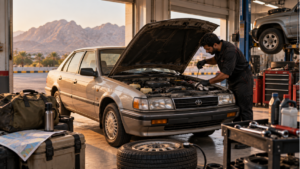
Preparing a car properly before a long drive is part of the ritual itself. Fluids, tyres, brakes, battery, cooling system and the small mechanical details that seem invisible on short trips suddenly matter much more when home is hundreds of kilometres away.
Reliability is not the opposite of romance.
It is what makes the romance possible.
You come back knowing the car differently
The interesting thing happens on the return journey.
The same car that felt special when you left now feels familiar in a deeper way.
You know where it is comfortable, where it becomes tiring and which noises are simply part of its vocabulary. You know how far the fuel really lasts. You know whether the seats deserve their reputation. You know what it feels like after hours of heat, traffic, empty roads and changing scenery.
Perhaps you even like it slightly less in certain ways.
That is not a failure.
Knowing a machine properly should involve discovering its weaknesses too.

The best road trips deepen affection because they replace imagination with experience. The car is no longer special simply because you believe it could take you somewhere remarkable.
It actually has.
And from then on, every scratch, photograph and fuel receipt belongs to the history you share with it.
Great cars deserve stories, not just mileage
Cars are designed to move, yet enthusiasts can sometimes become so focused on preserving them that movement becomes almost secondary. We worry about kilometres, stone chips, weather, resale values and keeping everything pristine.
Care matters. Preservation matters.
But there should also be a point to all that care.
A great car deserves more than being started on a Sunday morning, driven to coffee and returned before the afternoon gets warm.
It deserves at least one day when the odometer turns faster than expected. One journey where the landscape changes several times. One photograph far from home. One fuel receipt from somewhere you did not plan to stop. One story that begins with, “We decided to take the car…”

“One day, the mileage will matter far less than the places those miles took you.”
A proper road trip will show you what your car does brilliantly. It will expose the things it does badly. It will introduce irritating little habits, unexpected strengths and details no amount of polishing in the garage could ever reveal.
Most importantly, it will give the machine something every great car deserves.
A story worth coming home with.